


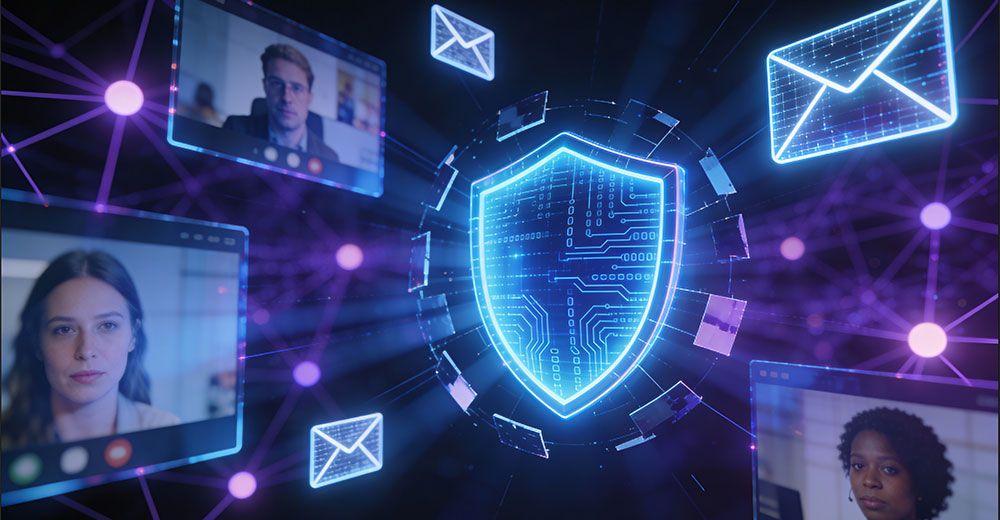
Deepfakes are emerging as a significant risk for any organization connected to the internet, particularly when exploited by nation-states and cybercriminals. What many see as fake videos or voice-cloned calls, experts say, is only the tip of the iceberg.
Identity Under Attack
“When people think about deepfakes, they often picture fake videos or voice-cloned calls,” said Arif Mamedov, CEO of Regula Forensics, a global developer of forensic and identity verification solutions. “In reality, the bigger risk runs much deeper. Deepfakes are dangerous because they attack identity itself, which is the foundation of digital trust.”
Unlike traditional fraud that relies on stolen or leaked data, deepfakes allow criminals to recreate existing people or generate entirely new identities — complete with faces, voices, documents, and believable behavior. “These identities can appear legitimate from the very first interaction,” Mamedov told TechNewsWorld.
He outlined three major risks: authentication breakdowns, rapid scaling of fraud through AI, and false confidence in existing security measures. “Our 2025 research shows that deepfakes don’t replace traditional fraud — they amplify it, exposing old weaknesses and making them far more costly,” he added.
Breaking Traditional Security Assumptions
Mike Engle, Chief Strategy Officer for 1Kosmos, explained that conventional security assumes authenticated users are legitimate. “Deepfakes break that assumption,” he said. “AI can now convincingly impersonate executives, employees, or customers, bypassing workflows that were never designed to detect manufactured identities.” Once a fake identity is enrolled, he noted, every downstream security control — from MFA to VPNs — can end up protecting the attacker instead of the organization.
David Lee, Field CTO at Saviynt, emphasized that deepfakes exploit human judgment. “When a voice or video sounds right, people move quickly, skip verification, and assume authority is legitimate,” he told TechNewsWorld. “A believable executive voice can authorize payments or override processes before security controls intervene.”
Financial Risks for Businesses
James E. Lee, president of the Identity Theft Resource Center, warned that deepfakes pose particular threats to smaller or thin-margined businesses. “Deepfakes can lead to data breaches, loss of control over systems and processes, and financial losses from both direct theft and unbudgeted expenses,” he said.
AI’s Role in Accelerating Threats
The accessibility of AI tools has accelerated deepfake proliferation. “Threat actors are increasingly leveraging open-source deepfake generators to produce convincing fakes efficiently,” noted Ruth Azar-Knupffer, co-founder of VerifyLabs, a deepfake detection firm. “Digital communications like video calls and social media have expanded attack surfaces, making deepfakes a growing vector for scams and disinformation.”
Mamedov added that deepfake creation is now cheap, fast, and high-quality. “What used to be an individual effort is now a plug-and-play ecosystem. Fraudsters can buy complete ‘persona kits’ including synthetic faces, voices, and digital backstories.” According to Regula, roughly one in three organizations has already experienced deepfake fraud, placing it on par with long-standing threats like document fraud and social engineering.
Training Employees to Spot Deception
Organizations are turning to training as one defense. KnowBe4, a cybersecurity training company, recently launched programs to help employees recognize deepfakes. “If you feel an emotional lever being pulled — fear, urgency, authority — that should be a signal to slow down and verify through another channel,” explained Perry Carpenter, KnowBe4 Chief Human Risk Management Strategist. He stressed that visual or audio cues are temporary indicators; attackers’ AI capabilities will quickly outpace them.
Rich Mogull, Chief Analyst at the Cloud Security Alliance, recommended behavioral cues and process controls rather than relying on visual or auditory signs. These include multi-step verification for transactions and using out-of-band channels to confirm executive requests.
Beyond Awareness: Verification is Key
Saviynt’s Lee cautioned that training alone isn’t enough. “Awareness helps people pause, but it doesn’t replace verification,” he said. “Employees must stop asking ‘Is this real?’ and start asking ‘What confirms this?’” He recommends secondary approval paths and eliminating voice or video as standalone trust signals.
“Deepfakes aren’t the core problem; they’re a stress test,” Lee added. “They expose how many organizations still rely on recognition instead of verification. The long-term solution is explicit, continuously enforced identity validation — when trust is no longer implicit, deepfakes lose their power.”
Leave a comment
Your email address will not be published. Required fields are marked *